
Mobile / Multi-Screen
Harmony
A social platform for musicians who want to collaborate, not just listen. I designed five connected flows and held them together as one product.

Role
Platform
Timeline
Tools
01 / Challenge
Challenge
Music apps are built for listening. If you actually play, there's nowhere to find people to play with, see what's happening locally, or show what you can do and when you're free.

02 / Research
Research
I interviewed working musicians about how they actually find people to play with. The answers were consistent: chemistry and shared taste matter more than follower counts, inconsistent commitment kills projects, and most collaborations happen through studio networking rather than any platform.
People wanted to hear someone play before reaching out, filter by instrument/skills, and talk to someone before committing. Those five needs became five flows, and I kept them consistent so the product felt dependable.
- Product Design
- Design Systems
- Prototyping
03 / Solution
Solution
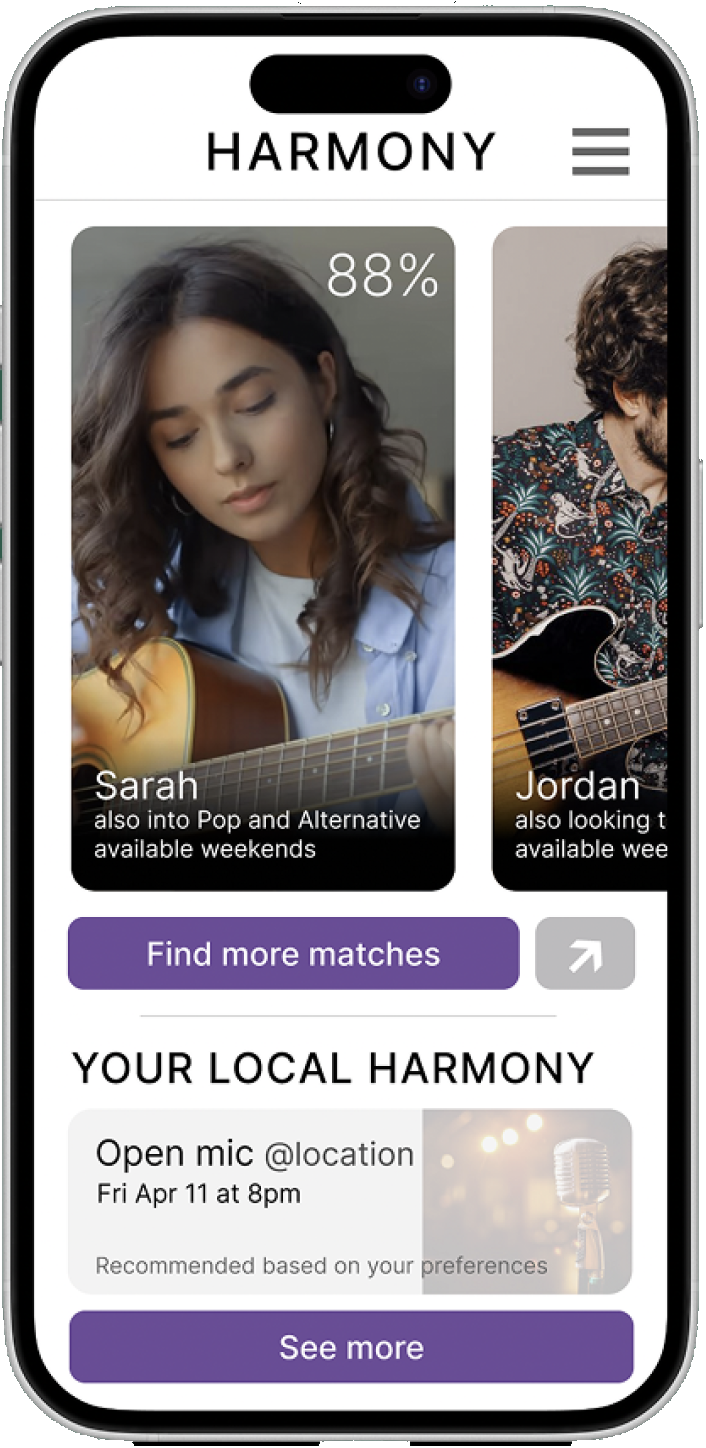
Compatibility Matching
Musicians told me they filter on genre, instrument, skill level, and level of commitment — not popularity. Matching surfaces those attributes directly, including availability, as mismatched sincerity was identified as a major cause of collaborations failing.

Artist Profiles
Every musician I spoke with wanted to hear someone play before reaching out. Profiles lead with audio samples, then genres, roles, experience, and what that person is actually looking to do — record, perform, or just jam. A first message has something behind it.

Local Events
Interviews split on local versus remote — people wanted both. Events covers the local half: open mics and sessions nearby, who's attending, and a thread to sort out details. It's the low-commitment way to meet someone before agreeing to anything.
04 / Impact
Impact
5
Connected Flows
2
Fidelity Stages
1
Designer
Everything moved from low fidelity to high fidelity based on what participants said rather than what looked good. The harder problem was consistency — five flows sharing one visual and interaction language, so moving from matching to a profile to a chat never felt like changing apps.
What I Learned
Consistency across a product is a different skill than one polished screen. Five flows taught me more about building a system than any single interface would have.
Yakabod
